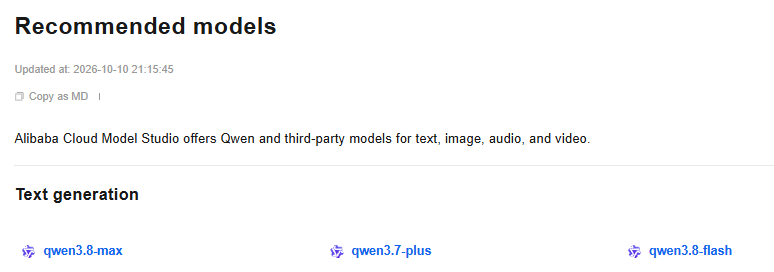
Qwen Models include hosted general-purpose models, downloadable open-weight checkpoints, coding models, vision and audio systems, image generators, embedding models, rerankers, and safety classifiers. There is no single best Qwen model: choose according to the task, required modalities, latency, budget, deployment route, hardware, and the licence of the exact checkpoint. For hosted applications, the current official starting tiers are qwen3.8-max, qwen3.7-plus, and qwen3.8-flash; for self-hosting, the correct choice depends on whether you need flagship capability, efficient local inference, coding specialisation, or multimodal input.
Last verified: October 7, 2026. Model IDs, aliases, prices, regional availability, context limits, lifecycle status, and licences can change. Verify the exact model card or provider page before deployment.
Qwen models at a glance
The table below is a decision-oriented snapshot, not a list of every Qwen repository, quantisation, adapter, or historical release.
| Need | Current starting point | Route | Main qualification |
|---|---|---|---|
| Highest-capability hosted general model | qwen3.8-max | QwenCloud | Flagship tier for difficult reasoning, coding, professional work, long context, vision, and tool-based workflows; it also has the highest token price among the three main hosted tiers. |
| Balanced hosted application model | qwen3.7-plus | QwenCloud | Suitable for general production applications that need text, image, video, coding, tools, and lower cost than the Max tier. |
| Lower-cost hosted generation | qwen3.8-flash | QwenCloud | Prioritises cost and throughput while retaining multimodal input, long context, tools, and structured output. |
| Audio, image, and video understanding | qwen3.8-omni-flash | QwenCloud | Accepts text, images, audio, and video, but this non-realtime model returns text rather than generated audio. |
| Realtime voice and video interaction | qwen3.8-omni-flash-realtime | QwenCloud | Designed for full-duplex interactive applications and produces text and audio; it uses realtime protocols and modality-based pricing. |
| Largest current downloadable general checkpoint | Qwen/Qwen3.8-2.4T-A95B | Open-weight deployment | A 2.4-trillion-parameter MoE model with 95 billion activated parameters. It requires large-scale infrastructure and is not identical to hosted qwen3.8-max. |
| Deployment-friendly current multimodal checkpoint | Qwen/Qwen3.8-27B | Open-weight deployment | Dense 27B model with image and video understanding, flexible thinking, and an Apache-2.0 licence. |
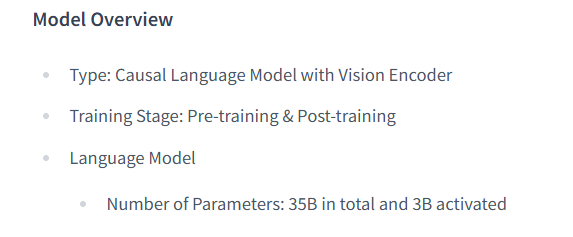
| Efficient multimodal MoE deployment | Qwen/Qwen3.6-35B-A3B | Open-weight deployment | 35 billion total parameters with 3 billion activated per token; active parameters do not represent its total storage requirement. |
| Smaller local multimodal model | Qwen/Qwen3.5-4B | Open-weight deployment | A smaller Apache-2.0 checkpoint for constrained local experiments; actual speed and memory use depend on precision, context, runtime, and hardware. |
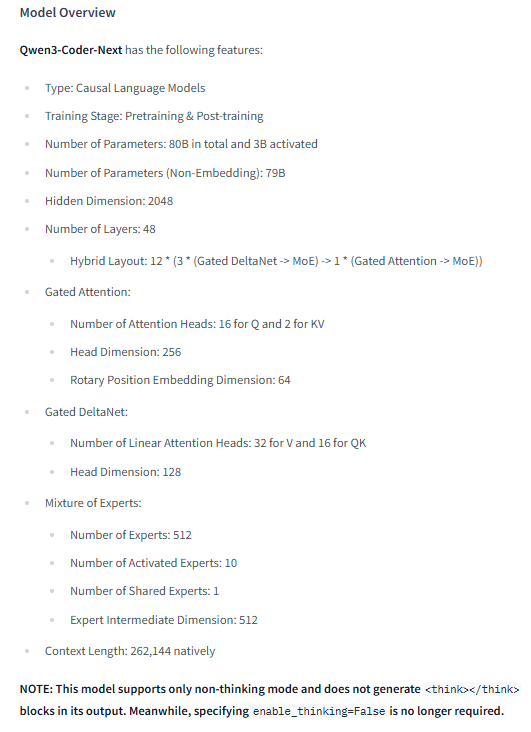
| Local coding and software agents | Qwen/Qwen3-Coder-Next | Open-weight deployment | Specialised coding MoE with 80 billion total and 3 billion activated parameters; it operates in non-thinking mode. |
| Hosted image generation and editing | qwen-image-3.0-pro | Alibaba Cloud Model Studio | Current recommended Qwen image model for complex layouts, high detail, text-heavy designs, generation, and editing. |
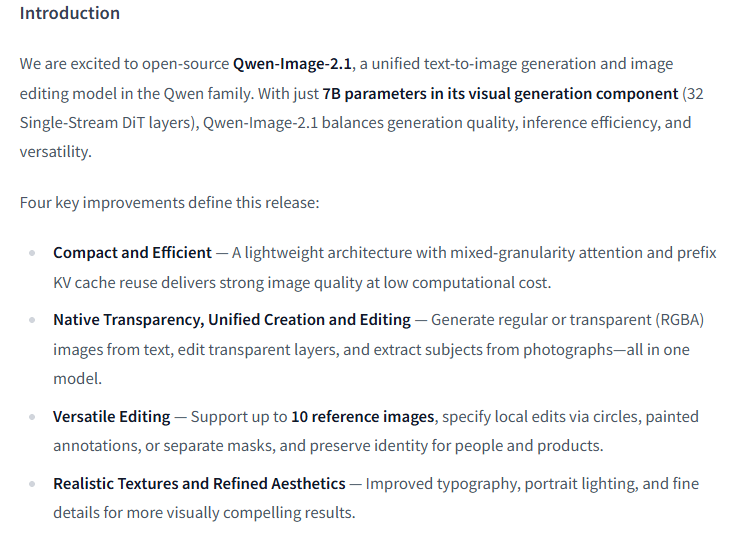
| Downloadable image generation and editing | Qwen/Qwen-Image-2.1 | Open-weight deployment | Supports generation, editing, multiple references, and transparent RGBA output, but its research licence restricts commercial use without a separate licence. |
| Speech recognition | Qwen/Qwen3-ASR-1.7B | Open-weight deployment | Dedicated automatic speech recognition model; it is not a general audio-reasoning or text-to-speech model. |
| Text-to-speech | Qwen3-TTS | Hosted or open-weight, depending on variant | Designed to generate speech with voice, style, rate, and emotional controls; it does not transcribe audio. |
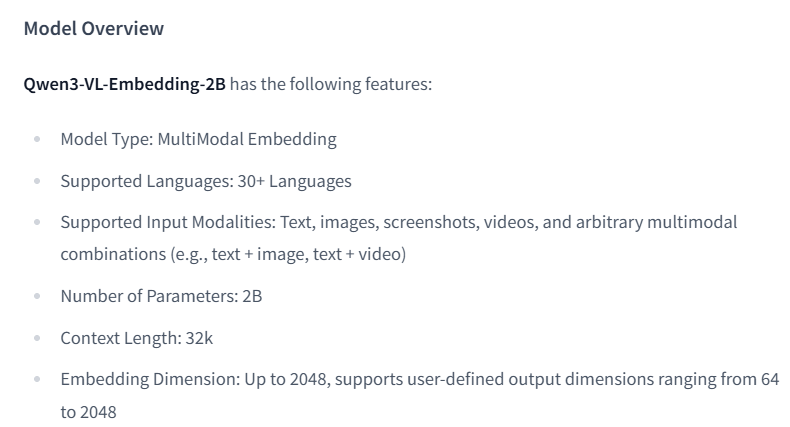
| Multimodal retrieval | Qwen3-VL-Embedding-2B | Open-weight deployment | Creates vectors from text, images, screenshots, and video for retrieval; it does not generate normal chat answers. |
| Reranking retrieved text | Qwen3-Reranker-0.6B | Open-weight deployment | Reorders an existing candidate set by relevance. It complements rather than replaces an embedding model. |
A practical selection process starts with the task category, then narrows the candidates by hosted versus local deployment, modalities, licence, acceptable latency, and cost. Model size should not be the first or only criterion.
What counts as a Qwen model?
The official Qwen organisation publishes many repositories, but not every repository represents a separately trained foundation model. Quantisations, dated snapshots, adapters, Base variants, provider aliases, and community conversions can multiply the apparent model count.
| Item | What it represents | How to treat it |
|---|---|---|
| Qwen Chat | A consumer application that uses Qwen models and tools. | Do not use its product name as an API model ID or assume that its plan includes API access. |
| Hosted API model | A provider-facing service ID such as qwen3.8-max. | Use it only with the provider, region, credentials, endpoint, protocol, and billing route that publish that ID. |
| Floating alias | An undated hosted ID that the provider can update. | Convenient for receiving improvements, but behaviour can change without an application-code change. |
| Dated snapshot | A hosted version pinned to a specific release date. | Useful for reproducibility, but it may receive an earlier retirement notice than the mainline alias. |
| Open-weight checkpoint | Model weights and configuration files such as Qwen/Qwen3.8-27B. | Check its exact model card, runtime support, architecture, licence, and hardware requirements. |
| Base checkpoint | A primarily pre-trained model intended for further training or research. | Do not treat it as a drop-in conversational assistant unless you supply suitable post-training or prompting. |
| Post-trained or instruct checkpoint | A model trained to follow instructions, chat, reason, or use tools. | Usually the appropriate starting point for direct application use. |
| Quantised variant | A lower-precision representation such as FP8, AWQ, GPTQ, INT4, or GGUF. | It normally remains the same underlying model family, with different memory, speed, compatibility, and possible quality trade-offs. |
| Community conversion or fine-tune | A derivative published by another organisation or user. | Do not label it an official Qwen release unless Qwen publishes or explicitly endorses it. |
| Qwen Code | An AI coding-agent application that can connect to models. | It is a software product, not a foundation-model checkpoint. |
| Qwen Deep Research | A research workflow, consumer feature, or specialised hosted service depending on context. | Do not classify the complete feature as the general Qwen model family. |
Alibaba Cloud Model Studio also lists third-party, domain-specific, legacy, and non-Qwen models. A model appearing in the same marketplace does not automatically make it part of the Qwen family. Wan image and video models, for example, should not be renamed Qwen models solely because Alibaba provides both.
Current hosted Qwen models
The current official Model Studio recommendations for general text generation are qwen3.8-max, qwen3.7-plus, and qwen3.8-flash. All three accept text, images, and video and return text. They also expose production features such as function calling, structured output, caching, batch processing, and optional built-in tools, although support can depend on the chosen API interface.
| QwenCloud model | Published context limits | Published token price | Best fit |
|---|---|---|---|
qwen3.8-max | 1M context; 991K maximum input, 983K in thinking mode, 131K maximum output, and 262K maximum reasoning allocation | US$2 per 1M input tokens and US$6 per 1M output tokens | Complex reasoning, difficult coding, professional workflows, long-horizon agents, visual analysis, and high-value tasks where quality justifies the price. |
qwen3.7-plus | 1M context; 991K maximum input, 983K in thinking mode, 131K maximum output, and 262K maximum reasoning allocation | For the ≤256K input tier, the page displays a 20% promotion: US$0.32 input and US$1.28 output per 1M tokens; list rates are US$0.40 and US$1.60 | General production applications that require a balance of capability, multimodal understanding, agents, and cost. |
qwen3.8-flash | 1M context; 991K maximum input, 983K in thinking mode, 131K maximum output, and 262K maximum reasoning allocation | US$0.15 per 1M input tokens and US$0.47 per 1M output tokens | High-volume workloads, extraction, classification, routine generation, and applications where low cost and throughput matter. |
qwen3.8-omni-flash | 1M context; accepts text, image, audio, and video and returns text | US$0.15 per 1M input tokens and US$0.47 per 1M output tokens on the QwenCloud page | Non-realtime analysis that combines speech, video, images, and text. |
qwen3.8-omni-flash-realtime | Realtime session model rather than the standard 1M-context request pattern | Modality-based rates for audio, text, image/video, and generated audio | Full-duplex voice, live video interaction, robotics, smart devices, and interactive assistants. |
These are QwenCloud prices checked on October 7, 2026. They are not universal Qwen pricing. Alibaba Cloud Model Studio regions, promotional periods, subscription plans, third-party providers, and cached or batch requests can use different rates.
Media inputs are converted into billable representations, so a nominal per-token rate does not by itself predict the cost of a long video or audio file. Estimate costs using the provider’s usage response and representative production samples.
Current open-weight Qwen models
Qwen’s downloadable checkpoints are not simply offline copies of the hosted service tiers. A hosted service can add modalities, built-in tools, different context defaults, safety systems, optimised serving, caching, and provider-specific interfaces.
| Official checkpoint | Architecture and modalities | Native context | Licence | Practical role |
|---|---|---|---|---|
Qwen/Qwen3.8-2.4T-A95B | MoE; 2.4T total and 95B activated parameters; text input and output; thinking-only checkpoint | 262,144 tokens, extendable up to 1,010,000 under the documented configuration | Custom Qwen3.8-Max License | Large-scale research and high-capability self-hosting where the organisation can operate an exceptionally large MoE model. |
Qwen/Qwen3.8-27B | Dense 27B model with a vision encoder; text, image, and video input; text output; switchable thinking | 262,144 tokens, with documented extension techniques for longer contexts | Apache-2.0 | A more deployment-friendly current multimodal checkpoint for general reasoning, coding, visual understanding, and agents. |
Qwen/Qwen3.8-Flash-Next | Multimodal experimental branch with specialised efficiency mechanisms | Check the current card and serving framework before deployment | Qwen Community License 1.0 | Advanced experimentation with the open checkpoint underlying the hosted Flash direction; its licence is not Apache-2.0. |
Qwen/Qwen3.6-35B-A3B | Multimodal MoE; 35B total and 3B activated parameters | 262,144 tokens, extendable up to 1,010,000 under the documented configuration | Apache-2.0 | Efficient server-side multimodal inference when a MoE deployment fits the runtime and hardware. |
Qwen/Qwen3-Coder-Next | Coding-focused MoE; 80B total and 3B activated parameters; non-thinking mode | 262,144 tokens | Apache-2.0 | Local or private coding agents, repository tasks, tool use, and software-engineering workflows. |
Qwen/Qwen3.5-4B | Dense 4B multimodal model with text, image, and video input | 262,144 tokens, although a local runtime can be configured lower | Apache-2.0 | A smaller current checkpoint for local experiments, edge-oriented evaluation, or lower-resource multimodal applications. |
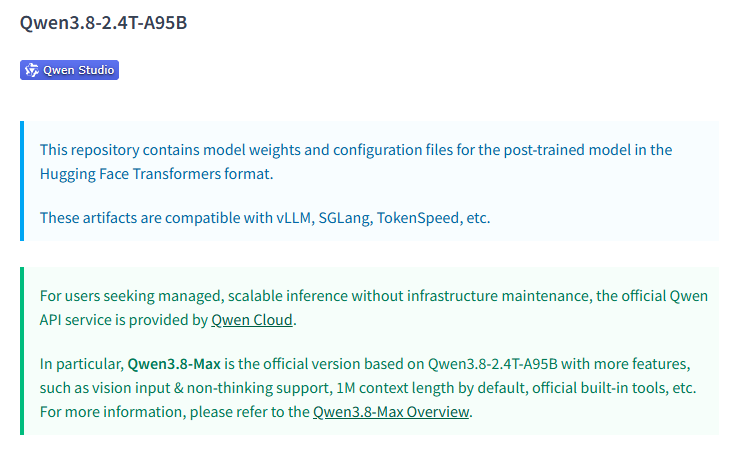
Qwen3.8-Max is not the same artifact as Qwen3.8-2.4T-A95B
The official model card states that hosted qwen3.8-max is based on Qwen3.8-2.4T-A95B, but the hosted version adds vision input, non-thinking support, a 1M default context, built-in tools, and managed production infrastructure. The downloadable checkpoint is text-only and thinking-only. The related names therefore do not make their request formats, modalities, defaults, or operational requirements interchangeable.
Specialised Qwen model families
| Family | Purpose | Current examples | Important distinction |
|---|---|---|---|
| Qwen Coder | Code generation, repository understanding, tool use, and software agents | Qwen/Qwen3-Coder-Next | A coding model is not the same product as Qwen Code, the coding-agent application. |
| Qwen vision-language | Understanding images, screenshots, documents, and video | Qwen/Qwen3.8-27B, Qwen/Qwen3.5-4B | A vision-language model analyses visual input and returns text; it does not automatically generate new images. |
| Qwen Omni | Understanding combinations of text, images, audio, and video | qwen3.8-omni-flash, qwen3.8-omni-flash-realtime | The non-realtime Flash model returns text, while the realtime variant can return text and audio. |
| Qwen Image | Image generation, image editing, references, layouts, and typography | qwen-image-3.0-pro, Qwen/Qwen-Image-2.1 | Image-generation models are different from vision-language models that only interpret images. |
| Qwen TTS | Generating spoken audio from text | Qwen3-TTS-12Hz-1.7B-CustomVoice | TTS produces speech; it does not transcribe incoming audio. |
| Qwen ASR | Speech recognition and transcription | Qwen/Qwen3-ASR-1.7B | ASR converts speech to text; use an Omni model when broader audio reasoning is required. |
| Qwen Embedding | Converting text or multimodal content into vectors for retrieval | qwen3.7-text-embedding, Qwen/Qwen3-VL-Embedding-2B | Embedding models retrieve candidates; they do not write a normal natural-language answer. |
| Qwen Reranker | Scoring and reordering already retrieved candidates | qwen3-rerank, Qwen/Qwen3-Reranker-0.6B | A reranker complements the initial embedding or search stage rather than replacing it. |
| Qwen Guard | Content moderation and safety classification | Qwen3Guard-Gen-8B and Stream variants | A Guard model can support application controls, but it does not guarantee legal compliance or eliminate unsafe outputs. |
How to read Qwen model names
| Name element | Meaning | What it does not guarantee |
|---|---|---|
3.8, 3.6, or 3.5 | A Qwen model generation or release branch. | A higher number does not make every model in that branch better for every specialised task. |
Max | A highest-capability hosted service tier. | It is not a parameter count and does not identify a downloadable checkpoint by itself. |
Plus | A hosted tier balancing capability and cost. | It does not have one permanent architecture or price across generations and providers. |
Flash | A hosted tier or model direction emphasising efficiency and lower cost. | It does not mean the same parameter count or licence in hosted and open releases. |
27B | Approximately 27 billion parameters in the named model; for a dense model, all layers participate in each token’s computation. | It does not provide an exact VRAM requirement without precision, context, runtime, and batch details. |
2.4T-A95B | Approximately 2.4 trillion total parameters and 95 billion activated parameters per token in a MoE model. | The model does not require storage for only 95 billion parameters. |
35B-A3B | 35 billion total parameters with about 3 billion activated per token. | It does not automatically fit hardware sized for a dense 3B model. |
Base | A primarily pre-trained checkpoint intended for research or additional training. | It is not necessarily ready for instruction-following chat. |
Instruct or post-trained | A checkpoint trained to follow instructions or interact with users. | It does not guarantee the same thinking behaviour as another Instruct release. |
Thinking | A variant or mode designed to allocate more computation to reasoning. | Longer reasoning does not guarantee a correct answer and can increase latency and cost. |
Coder | A model specialised for programming and software-agent workflows. | It is not the same as the Qwen Code application. |
VL | Vision-language input, normally producing text. | It does not mean image generation. |
Omni | A multimodal family that can combine several media types. | The exact input and output modalities still depend on the individual model. |
Image | An image-generation or image-editing family. | It is not a general chat or visual-question-answering model. |
TTS and ASR | Text-to-speech and automatic speech recognition. | They are not interchangeable audio tasks. |
Embedding and Reranker | Initial vector retrieval and later relevance rescoring. | Neither is a normal answer-generating chat model. |
Next or Preview | An architectural branch, early release, or experimental direction. | It does not automatically mean the stable successor to every earlier model. |
| Date suffix | A snapshot tied to a particular provider release. | An undated alias is not necessarily identical or immutable. |
FP8, AWQ, GPTQ, or GGUF | A precision, quantisation, or packaging format. | It normally does not indicate a separately trained foundation model. |
Which Qwen model should you choose?
For a hosted general application
- Start with
qwen3.7-pluswhen you need a balanced production default. - Escalate difficult, high-value, long-horizon, or professional tasks to
qwen3.8-max. - Evaluate
qwen3.8-flashfor high-volume, lower-cost, or latency-sensitive requests.
Do not send every request to the most expensive model. A useful production pattern is to route routine work to Flash or Plus and reserve Max for tasks that fail quality checks or meet defined complexity criteria.
For coding and software agents
Use qwen3.8-max when you want a managed high-capability model with provider tools, multimodal input, and no local serving burden. Use Qwen/Qwen3-Coder-Next when the priority is a downloadable coding-specialised checkpoint, private deployment, or integration into a self-hosted coding agent.
A coding-labelled model is not automatically the best option for every request containing code. General models can be preferable when the task combines programming with documents, images, policy analysis, or broad professional reasoning. Test both routes on repository-level tasks, tool-call validity, test success, and recovery from failed commands.
For image, document, and video understanding
For hosted use, the current Max, Plus, and Flash tiers all accept image and video input. Choose between them using the same quality-versus-cost decision. For self-hosting, Qwen/Qwen3.8-27B is the current deployment-friendly dense multimodal option, while Qwen/Qwen3.6-35B-A3B provides a MoE alternative.
Use a Qwen Image model—not a vision-language model—when the required output is a newly generated or edited image.
For audio and realtime voice
- Use
qwen3.8-omni-flashto analyse mixed text, image, audio, and video inputs and return text. - Use
qwen3.8-omni-flash-realtimefor live, full-duplex interactions that return audio and text. - Use Qwen3-ASR for dedicated transcription.
- Use Qwen3-TTS for controlled speech generation.
For image generation and editing
Use hosted qwen-image-3.0-pro for managed generation, editing, dense visual layouts, and typography. Consider Qwen/Qwen-Image-2.1 for local research, multiple references, local editing, or transparent RGBA output, but read its non-commercial research licence before using the model materials in a commercial product.
For RAG and semantic search
A complete retrieval pipeline normally uses different models for different stages:
- An embedding model converts the query and corpus into vectors.
- A vector or hybrid search retrieves an initial candidate set.
- A reranker rescores the strongest candidates against the query.
- A generation model writes an answer using the selected context.
Use hosted qwen3.7-text-embedding with qwen3-rerank for a managed text pipeline. Evaluate Qwen3-VL-Embedding and its associated reranking family when the corpus includes screenshots, images, or video rather than only text.
For smaller local deployments
Qwen/Qwen3.5-4B is a more practical starting point than a 27B or trillion-parameter model when hardware is constrained. However, do not choose it solely because the parameter count is smaller. Confirm that the required runtime supports its architecture, multimodal processor, thinking parser, tool-call template, and chosen quantisation.
Hosted Qwen models vs open-weight checkpoints
| Decision factor | Hosted model | Open-weight checkpoint |
|---|---|---|
| Setup | Create credentials and call a managed endpoint. | Download the model, select a runtime, provision hardware, and operate the service. |
| Scaling | The provider handles serving capacity within account and model limits. | You manage concurrency, batching, multi-GPU communication, upgrades, and failover. |
| Pricing | Usage-based tokens, media units, tool calls, caching, or subscription credits. | Hardware, cloud compute, storage, bandwidth, electricity, engineering, and maintenance. |
| Model controls | Limited to the parameters, protocols, tools, and versions exposed by the provider. | Greater control over precision, runtime, context, adapters, and deployment topology. |
| Versioning | Floating aliases can change; dated snapshots improve reproducibility while available. | You can pin files and dependencies, but must manage updates and vulnerabilities. |
| Context and tools | Can include provider-optimised 1M context and built-in tools. | Depends on the checkpoint, serving engine, memory, templates, and extension configuration. |
| Privacy | Inputs are processed under the provider and account terms. | Inference can stay inside controlled infrastructure, but external tools, telemetry, downloads, and integrations can still create network data flows. |
| Licence | Governed by service terms and the selected plan. | Governed by the exact model-card licence, which varies between Qwen checkpoints. |
| Best fit | Fast implementation and managed production inference. | Infrastructure control, custom serving, research, or workloads with a justified self-hosting requirement. |
Qwen context windows and output limits
A stated 1M-token context does not necessarily mean that an application can submit a 1M-token prompt and still receive a long answer. Total context can include the prompt, media representations, tool messages, internal reasoning allocation, and generated output.
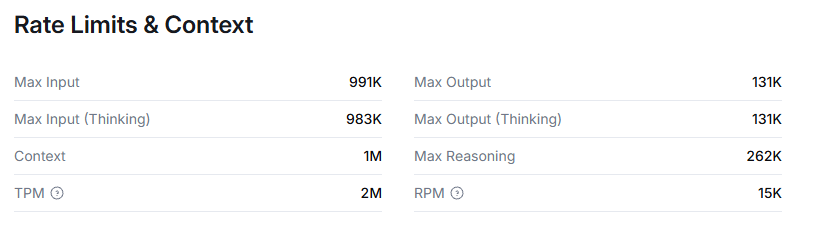
For the current QwenCloud Max, Plus, Flash, and Omni Flash pages, the documented values include:
- 1M total context.
- 991K maximum normal input.
- 983K maximum input in thinking mode.
- 131K maximum final output.
- 262K maximum reasoning allocation.
Open checkpoints such as Qwen3.8-27B, Qwen3.6-35B-A3B, and Qwen3.5-4B document a native context of 262,144 tokens and optional extension techniques for longer contexts. Extension is not free: longer sequences increase KV-cache memory, can reduce throughput, and may affect quality. A local serving framework can also default to a shorter limit than the model card.
Record all of the following when comparing context claims: exact checkpoint, provider, API, native limit, extended limit, maximum output, thinking allocation, runtime, context configuration, and media-token treatment.
Dense vs MoE Qwen models
A dense model such as Qwen3.8-27B generally uses all model layers for each token. A Mixture-of-Experts model routes each token through a subset of specialised experts.
The notation 35B-A3B means approximately 35 billion total parameters and 3 billion activated parameters per token. It does not mean that the complete model stores only 3 billion parameters. Similarly, 2.4T-A95B still represents an exceptionally large checkpoint even though only part of the expert capacity is activated for each token.
- Total parameters strongly affect weight storage and distribution requirements.
- Activated parameters help describe per-token expert computation.
- KV cache grows with context, batch size, architecture, and precision.
- Runtime overhead includes activations, buffers, vision encoders, communication, and serving software.
- Throughput depends on hardware, expert routing, interconnect, batching, framework, and quantisation—not only the activated-parameter number.
Base, post-trained, and thinking variants
A Base checkpoint is primarily intended for additional training, research, or specialised adaptation. A post-trained or instruct model is usually the correct starting point for direct conversations and application prompts.
Thinking behaviour also varies:
- Some Qwen models can switch between thinking and non-thinking modes.
Qwen3.8-2.4T-A95Bis documented as a thinking-only open checkpoint.Qwen3-Coder-Nextis documented as non-thinking and does not emit<think>blocks.- Hosted models can expose provider-specific controls for enabling thinking or setting reasoning effort.
Thinking mode can improve difficult reasoning, but it can also increase latency and output-token cost. Evaluate it separately from direct-response mode, and do not assume that a longer reasoning trace guarantees correctness.
Qwen model licences and commercial use
“Qwen is open source” is too broad to be reliable. Some Qwen checkpoints use Apache-2.0, while others use custom community, research, or scale-dependent licences. The licence of one checkpoint does not transfer to another model with a similar name.
| Checkpoint or family | Licence shown on the official card | Practical implication |
|---|---|---|
Qwen3.8-27B | Apache-2.0 | Review Apache obligations and applicable laws, but do not assume that provider service terms or third-party derivatives are identical. |
Qwen3.6-35B-A3B | Apache-2.0 | The official checkpoint uses Apache-2.0; a community conversion should still identify its provenance and modifications. |
Qwen3.5-4B | Apache-2.0 | A smaller official checkpoint with a permissive licence, subject to the licence text and applicable law. |
Qwen3-Coder-Next | Apache-2.0 | The model licence is separate from the licence, terms, and provider cost of a coding-agent application. |
Qwen3.8-2.4T-A95B | Custom Qwen3.8-Max License | Broad use rights include conditions for very large products and certain high-revenue Model-as-a-Service or AI work-assistant businesses. Read the exact licence before commercial deployment. |
Qwen3.8-Flash-Next | Qwen Community License 1.0 | A separate Qwen licence applies, including specific conditions for commercial Model-as-a-Service and AI work-assistant businesses. |
Qwen-Image-2.1 | Qwen Research License Agreement | The model materials are licensed for non-commercial research or evaluation; commercial use requires a separate licence from Qwen. |
| Qwen3-TTS, Qwen3-ASR, Qwen3-VL-Embedding, Qwen3-Reranker, and Qwen3Guard examples linked in this article | Apache-2.0 on the cited model cards | Check the exact size and variant rather than assuming that every future member of the family will retain the same licence. |

Review the exact licence file for the specific checkpoint, derivative, deployment method, and intended use. A downloadable model is not automatically unrestricted, and an API subscription does not replace model-licence or output-rights review.
Running Qwen models locally
Start from an official Qwen model card, then verify that the selected runtime supports the exact architecture and modalities. Qwen model cards currently document combinations of Transformers, vLLM, SGLang, KTransformers, llama.cpp-compatible quantisations, Ollama, LM Studio, and specialised frameworks such as ComfyUI for image models. Support is model-specific.
For a supported desktop setup, follow our local Qwen guide for Ollama or LM Studio.
Estimate weight memory carefully
A rough weight-only estimate is:
weight_memory ≈ parameter_count × bytes_per_parameter

BF16 or FP16 ≈ 2 bytes per parameter
INT8         ≈ 1 byte per parameter
4-bit        ≈ 0.5 byte per parameter
This is not a complete VRAM or RAM requirement. Add memory for the KV cache, activations, runtime buffers, vision or audio encoders, batching, temporary workspace, and framework overhead. A MoE model normally needs access to all stored experts even though only a subset is activated for each token.
Choose the precision and package deliberately
- BF16 or FP16: closer to the original weights but requires more memory.
- FP8: can reduce memory and improve serving efficiency on compatible hardware and runtimes.
- AWQ or GPTQ: GPU-oriented quantisation formats whose quality and runtime support vary.
- GGUF: commonly used with llama.cpp-based applications, including compatible Ollama and LM Studio workflows.
- Community conversion: may be useful, but verify the publisher, source checkpoint, quantisation method, licence, file integrity, and required custom code.
Loading successfully is not the same as being usable. Measure token speed, time to first token, context capacity, multimodal latency, quality loss, tool-call validity, and stability under the intended concurrency.
Local deployment is not automatically private or free
Self-hosting replaces provider token charges with infrastructure and operational costs. Model downloads, external search tools, telemetry, package managers, MCP servers, remote storage, and third-party interfaces can still transmit data. Review the complete application data flow rather than treating the location of inference as the only privacy control.
Qwen API aliases, snapshots, and model lifecycle
A floating API alias such as qwen3.8-max can be updated by the provider. A date-suffixed snapshot is intended to preserve a particular provider release for a period, which can improve reproducibility.
After selecting a hosted model, use our Qwen API setup and regional endpoints guide to configure the correct route.
| Use case | Preferred versioning approach | Trade-off |
|---|---|---|
| Experimentation and access to provider improvements | Floating mainline alias | Behaviour can change even when application code and model ID do not. |
| Regression-sensitive production system | Dated snapshot when the provider offers one | More stable behaviour, but the snapshot can be retired earlier. |
| Long-lived regulated or audited workflow | Pin a snapshot, prompts, SDK, parameters, tools, evaluation set, and source date | Requires an explicit migration and revalidation process. |
| Self-hosted checkpoint | Pin the model revision, files, runtime, container, dependencies, templates, and quantisation | Your team owns patching, compatibility, and lifecycle management. |
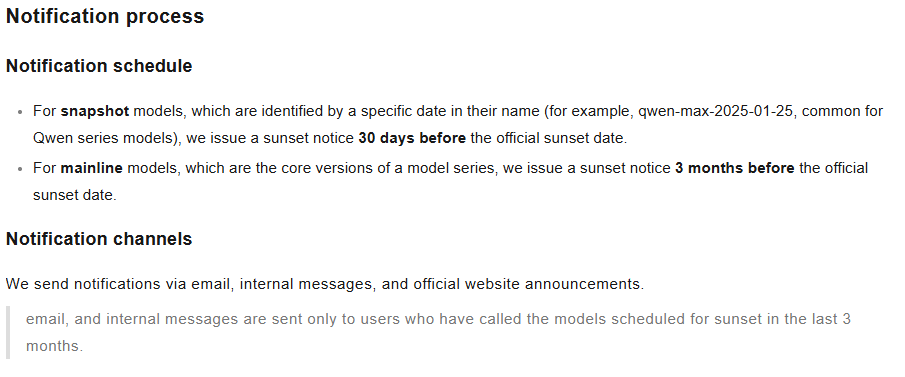
Alibaba Cloud’s current lifecycle policy states that snapshot models normally receive a sunset notice 30 days before retirement, while mainline models normally receive three months’ notice. After retirement, API calls fail. Monitor lifecycle notices, record a migration target, and rerun quality and cost tests before switching.
How to evaluate Qwen models for your workload
- Define the real tasks. Build a fixed set of representative prompts, documents, images, audio samples, repositories, or retrieval queries.
- Set acceptance criteria. Decide how factual accuracy, code correctness, JSON validity, OCR quality, citation support, latency, and cost will be judged.
- Record exact identities. Save provider, region, model ID, snapshot, checkpoint revision, runtime, quantisation, parameters, and test date.
- Keep conditions comparable. Use the same prompts, tools, retrieved context, temperature, token limits, and output validator where the models support them.
- Run more than once. Non-deterministic generation can make a single result misleading.
- Use executable validation. Run code and tests, parse structured output, verify citations, calculate retrieval metrics, and inspect generated media.
- Measure cost per accepted result. A cheaper token rate can be more expensive when retries, long reasoning, failures, or human correction increase.
- Test failure cases. Include ambiguous prompts, long inputs, malformed tool results, adversarial documents, unsupported media, and provider errors.
- Evaluate safety at the application level. Test the model together with its tools, permissions, system prompt, data, moderation, and human-review process.
- Repeat after upgrades. Revalidate floating aliases, new snapshots, runtime changes, quantisations, and prompt-template changes.
Common Qwen model selection and deployment mistakes
| Symptom | Likely cause | Corrective action |
|---|---|---|
| API returns “model not found” | A Hugging Face repository name, model ID from another provider, retired snapshot, or model unavailable in the selected region was used. | Copy the exact ID from the same provider and region as the key and endpoint. |
| A valid API key is rejected | The key belongs to another product, plan, workspace, or region. | Treat provider, plan, region, key, endpoint, and model as one configuration. |
| Image input is ignored | The selected model is text-only, the message format is wrong, or the runtime lacks the vision processor. | Confirm the exact model modalities and follow its current multimodal request format. |
| The application expects the vision model to create an image | Visual understanding was confused with visual generation. | Use a Qwen Image model for image output. |
| The embedding model returns vectors instead of prose | An embedding endpoint was used as a chat model. | Use embeddings for retrieval, then call a generation model with the retrieved context. |
| RAG results remain weak after adding embeddings | The candidate set is noisy or no reranking stage exists. | Evaluate a Qwen reranker after initial retrieval and measure recall and ranking quality separately. |
| A MoE model does not fit hardware sized for its activated parameters | Activated parameters were mistaken for total stored weights and runtime memory. | Plan using total weights, precision, KV cache, runtime overhead, context, and distribution strategy. |
| Local context is shorter than the model-card maximum | The serving engine uses a lower default or available memory cannot support the full window. | Inspect the runtime configuration and increase context only after measuring memory and quality. |
| Output ends early | The output cap, context budget, provider limit, or reasoning allocation was reached. | Check maximum output separately from total context and leave space for the required answer. |
| Tool calls are malformed | The model, runtime, parser, chat template, or API protocol is incompatible with the tool schema. | Use the official tool template and parser for the exact model and validate arguments before execution. |
| The model’s behaviour changes without a deployment | A floating hosted alias was updated. | Inspect the provider changelog, compare a dated snapshot, and rerun the regression suite. |
| A planned commercial deployment fails licence review | The team assumed every Qwen checkpoint used Apache-2.0. | Read the exact licence file before committing to the model or derivative. |
Frequently asked questions
What are Qwen models?
Qwen models are Alibaba’s family of general, multimodal, coding, image, speech, retrieval, reranking, and safety models. Some are offered as managed hosted services, while others are published as downloadable checkpoints under model-specific licences.
What is the latest Qwen model?
There is no single answer across all categories. On October 7, 2026, the official hosted recommendations include qwen3.8-max, qwen3.7-plus, and qwen3.8-flash for general text and multimodal work. Current open releases include Qwen3.8 checkpoints, while specialised image, audio, embedding, reranking, and safety families follow separate release lines.
Which Qwen model is best?
The best model is the one that meets the task’s acceptance criteria at an acceptable cost and latency. Use Max for the hardest hosted work, Plus as a balanced hosted default, Flash for lower-cost scale, Coder for self-hosted software agents, Omni for mixed media, Qwen Image for image output, and dedicated embedding or reranking models for retrieval.
What is the difference between Qwen Max, Plus, and Flash?
They are hosted service tiers rather than parameter-count labels. Max targets the highest capability, Plus balances performance and cost, and Flash prioritises lower cost and throughput. Their exact architecture, price, context, and features can change between generations.
Are all Qwen models open source?
No. Some checkpoints use Apache-2.0, some use custom Qwen licences, some use a research-only licence, and hosted models are accessed under service terms. “Open-weight” is often more precise than “open source” when weights are available but the full training data and process are not.
Can Qwen models be used commercially?
Commercial permission depends on the exact checkpoint and deployment. Apache-2.0 checkpoints have different terms from Qwen3.8-Max, Qwen Community, and Qwen Research licences. Hosted API use is additionally governed by the provider agreement. Review the exact licence and intended use rather than applying one answer to the entire family.
What does A3B or A95B mean?
The A value identifies approximately how many parameters are activated for each token in a Mixture-of-Experts model. A 35B-A3B model still stores approximately 35 billion total parameters; it is not equivalent to a dense 3B model in storage or deployment requirements.
Which Qwen model should I run locally?
For constrained experiments, evaluate a smaller official checkpoint such as Qwen3.5-4B. For stronger multimodal quality, consider Qwen3.8-27B if the infrastructure supports it. For efficient server-side MoE inference, evaluate Qwen3.6-35B-A3B. Coding agents should also test Qwen3-Coder-Next. Do not select hardware from the model name alone.
Are Qwen API IDs the same as Hugging Face names?
Not necessarily. qwen3.8-max is a hosted QwenCloud model ID, while Qwen/Qwen3.8-2.4T-A95B is a Hugging Face repository. Related names can identify different capabilities, modalities, defaults, licences, and request formats.
Can I use Qwen models through an OpenAI-compatible API?
Many hosted Qwen models and self-hosted runtimes expose OpenAI-compatible interfaces, but compatibility is model- and provider-specific. Some specialised APIs use native DashScope or realtime protocols instead. Verify the exact model page rather than assuming one endpoint works for the entire Qwen family.
Sources checked
The following primary sources were checked on October 7, 2026:
- Alibaba Cloud Model Studio recommended-model catalog.
- Official Qwen organisation on Hugging Face and its official model collections.
- Qwen3.8-Max, Qwen3.7-Plus, Qwen3.8-Flash, Qwen3.8-Omni-Flash, and Qwen3.8-Omni-Flash-Realtime QwenCloud pages.
- Qwen3.8-2.4T-A95B model card and Qwen3.8-Max License.
- Qwen3.8-27B, Qwen3.6-35B-A3B, and Qwen3.5-4B model cards.
- Qwen3-Coder-Next model card.
- Qwen3.8-Flash-Next model card and Qwen Community License 1.0.
- Qwen-Image-2.1 model card and Qwen Research License Agreement.
- Qwen3-TTS and Qwen3-ASR model cards.
- Qwen3-VL-Embedding, Qwen3-Reranker, and Qwen3Guard model cards.
- Alibaba Cloud Model Studio lifecycle, deprecation, and retirement policy.