DeepSeek V4.1 Flash vs V4 Pro is not simply a newer-model-versus-better-model decision. V4.1 Flash is the stronger default for most new DeepSeek API workloads because it costs less, supports image input, has five times the published concurrency, and leads V4 Pro on many of DeepSeek’s current agentic and coding benchmarks. V4 Pro remains available through deepseek-v4-pro. Choose it when you specifically need built-in web_search through the Responses API, which Flash ignores, or test it for text-only workloads where stronger results translate into fewer errors or less human repair.
Independent-site disclosure: This is an independent comparison and is not affiliated with DeepSeek.
Last verified: October 9, 2026. DeepSeek model mappings, prices, aliases and lifecycle decisions can change. Recheck the current official model table and change log before deploying either model.
Testing note: No paid API benchmark was executed during preparation of this article. Performance comparisons below are identified as DeepSeek-published results, not independent firsthand findings. No response, latency, token count or task cost has been fabricated.
Quick verdict: which model should you use?
| Your workload | Better starting point | Why | What to verify |
|---|---|---|---|
| New general API integration | deepseek-flash | Lower prices, higher published concurrency, current model generation and broad feature support | Quality on your representative prompts and tools |
| Built-in web search through Responses | deepseek-v4-pro | Pro supports server-side web_search; Flash ignores this built-in tool | Verify returned sources and applicable search and token charges |
| Image or screenshot analysis | deepseek-flash | V4.1 Flash supports image input; V4 Pro currently does not | OCR, chart interpretation and visual-detail accuracy |
| Coding agents and repository work | Start with V4.1 Flash | It leads V4 Pro on several current vendor-reported terminal, software-engineering and security-agent evaluations | Patch correctness, test quality, tool rounds and repair time |
| High-volume production | deepseek-flash | Published concurrency is 2,500 versus 500, with materially lower token prices | Actual queue time, provider reliability and accepted-task cost |
| Input-heavy agents with repeated context | deepseek-flash | Its architecture and cache pricing are designed for efficient long-prefix processing | Real cache-hit rate and task quality |
| Difficult text-only knowledge or reasoning | Test both | V4 Pro retains an advantage on some published reasoning and knowledge evaluations | Final correctness, reasoning-token use and human correction effort |
| Existing validated V4 Pro application | Do not switch blindly | A newer and cheaper model does not guarantee equivalent behavior | Regression tests, structured output, tools, long context and fallbacks |
| Self-hosting | V4.1 Flash is the more practical of the two | Its active-compute design is smaller and more efficient | Full weight storage, runtime support, quantization effects and infrastructure cost |
Practical conclusion: start with V4.1 Flash unless you need Pro’s built-in Responses web search, or a matched evaluation demonstrates a repeatable Pro advantage worth its higher price, lower concurrency and lack of image input.
Current model names and lifecycle status
The first step is identifying the exact models being compared. DeepSeek uses API-facing model IDs that can map to named model versions, and older IDs can remain accepted after their original models have been retired.
| Comparison item | Current first-party API ID | Mapped model version | Current status |
|---|---|---|---|
| DeepSeek V4.1 Flash | deepseek-flash | DeepSeek‑V4.1‑Flash | Current Flash route |
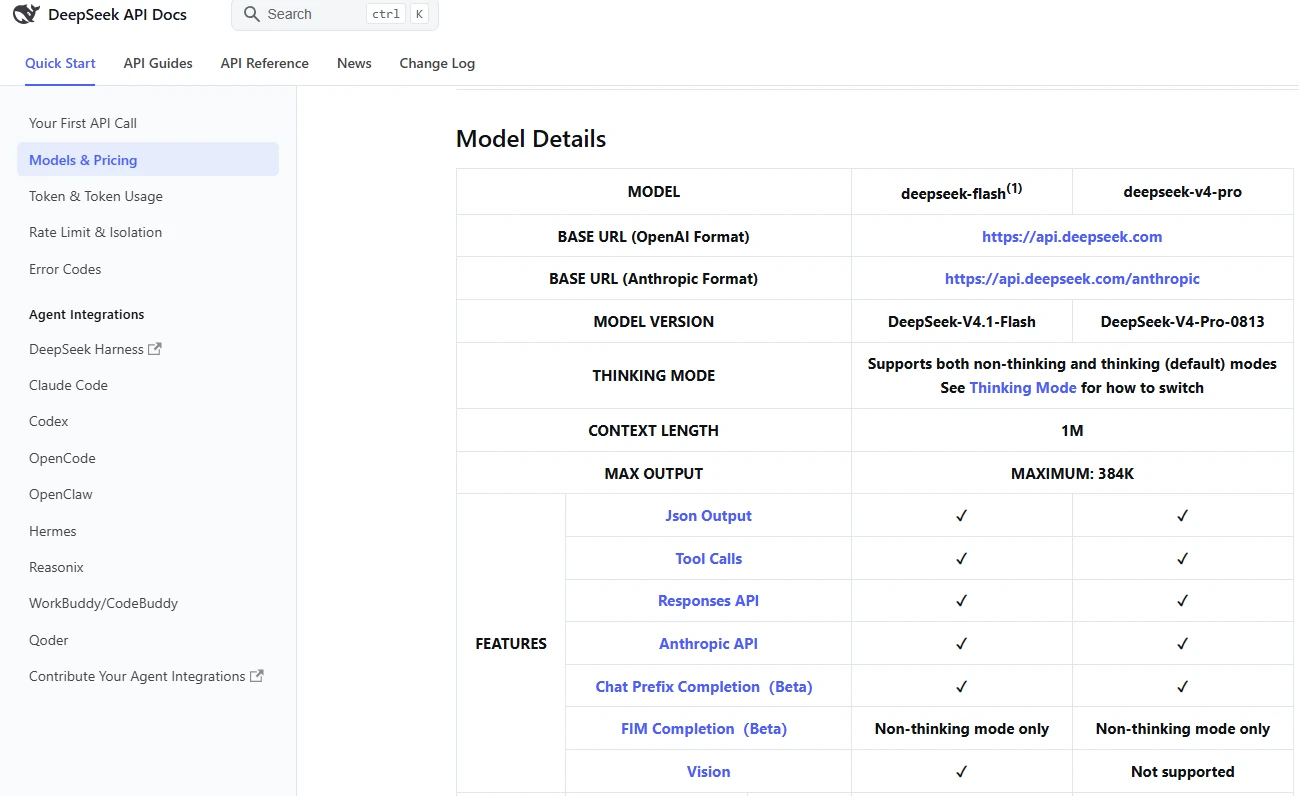
| DeepSeek V4 Pro | deepseek-v4-pro | DeepSeek‑V4‑Pro‑0813 | Still listed and available at verification time |
| Legacy V4 Flash ID | deepseek-v4-flash | Requests are served by V4.1 Flash | Original model retired; temporary compatibility alias |
| Legacy Vision Exp ID | deepseek-v4-flash-vision-exp | Requests are served by V4.1 Flash | Original model retired; temporary compatibility alias |
| DeepSeek V4.1 Pro | No separate current ID listed | No separate model shown in the current first-party model table | Do not assume availability until DeepSeek publishes it |
Was V4 Pro discontinued?
No—not according to the current official change log. DeepSeek’s original V4.1 Flash announcement said that deepseek-v4-pro requests would begin routing to V4.1 Flash on September 14, 2026. The later lifecycle note in the current change log says that, in response to user demand, DeepSeek decided to continue providing V4 Pro API service after that date with its billing method unchanged.
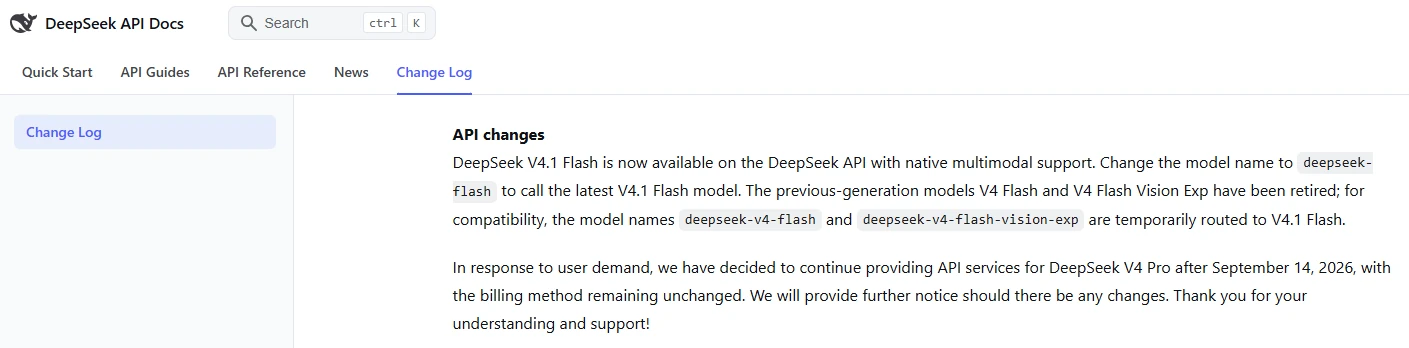
Older articles may still repeat the original phase-out plan. For lifecycle questions, use the current DeepSeek API change log rather than the launch headline alone.
The current Models & Pricing page continues to list both IDs. That confirms current availability, not a promise that V4 Pro will remain indefinitely.
DeepSeek V4.1 Flash vs V4 Pro specifications
| Specification | DeepSeek V4.1 Flash | DeepSeek V4 Pro | Decision impact |
|---|---|---|---|
| First-party API ID | deepseek-flash | deepseek-v4-pro | Use current IDs rather than retired aliases. |
| Mapped version | DeepSeek‑V4.1‑Flash | DeepSeek‑V4‑Pro‑0813 | Record the mapping with every production evaluation. |
| Architecture | Multimodal MoE with Causal Encoder–Decoder architecture | Text-focused MoE based on V4 Pro architecture with DSpark speculative decoding | Flash is optimized for lower input and decoding cost. |
| Published parameter scale | 552B backbone; 8B active during prefill and 16B during decode | 1.6T total; 49B activated | Active compute and full weight storage are different concepts. |
| Input modalities | Text and images | Text | Vision requirements select Flash immediately. |
| Output modality | Text | Text | Neither current route is an image generator. |
| Context length | 1M tokens | 1M tokens | Equal published capacity does not prove equal retrieval quality. |
| Maximum output | 384K tokens | 384K tokens | Allocate output inside the total context budget. |
| Thinking mode | Thinking and non-thinking; thinking enabled by default | Thinking and non-thinking; thinking enabled by default | Match the same effort in comparisons. |
| JSON Output | Supported | Supported | Validate syntax and business meaning in the application. |
| Tool Calls | Supported | Supported | A checkbox does not prove equal tool reliability. |
| Responses API | Supported | Supported | Useful for Codex-style integrations. |
| Built-in Responses web_search | Ignored | Supported | Select Pro for this server-side tool; external or standalone retrieval is a separate route. |
| Anthropic-compatible API | Supported | Supported | Review DeepSeek-specific compatibility limits. |
| Chat Prefix Completion | Supported in Beta | Supported in Beta | Test Beta behavior before production. |
| FIM Completion | Non-thinking mode only | Non-thinking mode only | Relevant to code infilling workflows. |
| Published concurrency | 2,500 | 500 | Flash offers five times the published concurrent-request capacity. |
| Open-weight release | Yes | Yes | Hosted API and self-hosted checkpoints remain separate deployments. |
| Model licence | MIT | MIT | Review all dependencies, tools and downstream obligations separately. |
API pricing: Flash is materially cheaper
DeepSeek bills the first-party API per one million tokens. Input pricing differs according to whether the prompt tokens are cache hits or cache misses, and both models use separate peak and off-peak rates.
| Price per 1M tokens | V4.1 Flash off-peak | V4.1 Flash peak | V4 Pro off-peak | V4 Pro peak |
|---|---|---|---|---|
| Cache-hit input | $0.003 | $0.006 | $0.022 | $0.044 |
| Cache-miss input | $0.15 | $0.30 | $0.66 | $1.32 |
| Output and reasoning | $0.60 | $1.20 | $1.98 | $3.96 |
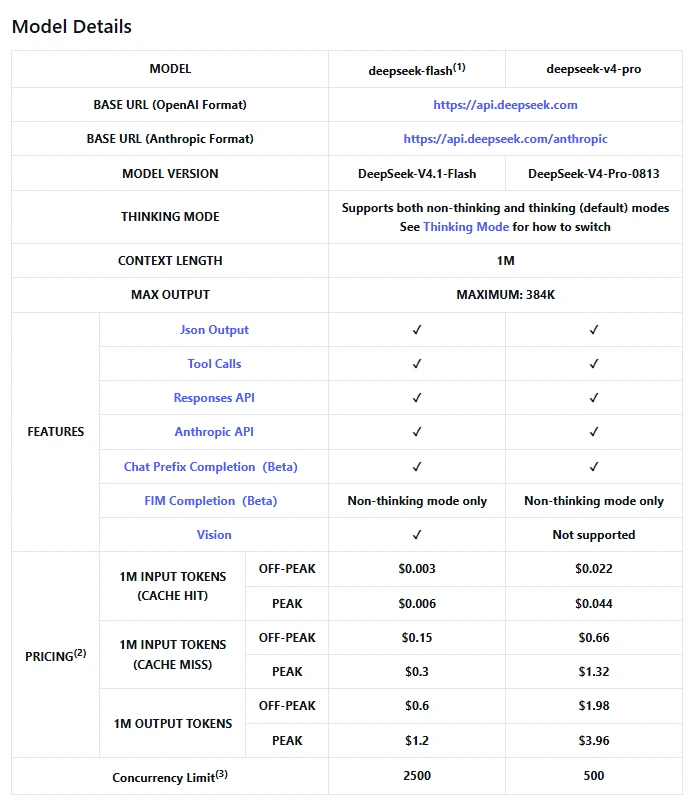
Prices verified October 9, 2026. These are first-party US-dollar list rates. Third-party providers can charge different prices and may serve different snapshots or quantizations.
At the current off-peak rates, V4.1 Flash is approximately:
- 86.4% cheaper for cache-hit input.
- 77.3% cheaper for cache-miss input.
- 69.7% cheaper for output and reasoning tokens.
Peak hours are currently 01:00–04:00 and 06:00–10:00 UTC, Monday through Friday, excluding Chinese public holidays. All other periods—including weekends and Chinese public holidays—are off-peak.
Worked cost example
Assume an agent workflow processes 10 million cached input tokens, 1 million uncached input tokens and 1 million output or reasoning tokens:
| Model and period | Calculation | Estimated model charge |
|---|---|---|
| V4.1 Flash off-peak | 10 × $0.003 + 1 × $0.15 + 1 × $0.60 | $0.78 |
| V4 Pro off-peak | 10 × $0.022 + 1 × $0.66 + 1 × $1.98 | $2.86 |
| V4.1 Flash peak | 10 × $0.006 + 1 × $0.30 + 1 × $1.20 | $1.56 |
| V4 Pro peak | 10 × $0.044 + 1 × $1.32 + 1 × $3.96 | $5.72 |
This example excludes retries, external tools, image input, failed agent loops, network services, observability and human correction. The meaningful comparison is cost per accepted task, not cost per token alone.
Vision: V4.1 Flash is the only choice of these two
V4.1 Flash currently accepts both image and text input. V4 Pro does not support image input in the first-party API model table. That makes Flash the direct choice for:
- Reading screenshots and application interfaces.
- Explaining charts and diagrams.
- Extracting visible information from document images.
- Inspecting photos or visual evidence.
- Visual coding-agent or browser-agent workflows.
Image understanding is not image generation. Both current API routes return text. V4.1 Flash can analyze an input image, but it does not return a newly generated PNG or JPEG.
Do not infer V4 Pro vision support from the consumer application’s ability to accept images. Consumer features and API model modalities must be verified separately.
Coding and agent benchmarks
DeepSeek’s current V4.1 Flash model card reports a clear Flash advantage on many agentic evaluations. These are vendor-published results, not an independent guarantee of performance in your repository.
| DeepSeek-published benchmark | V4.1 Flash | V4 Pro | Published leader |
|---|---|---|---|
| Terminal-Bench 2.1 | 90.6 | 87.9 | V4.1 Flash |
| Terminal-Bench 3.0 | 30.0 | 11.8 | V4.1 Flash |
| Terminal-Bench 4.0 | 31.2 | 12.4 | V4.1 Flash |
| DeepSWE v1.1 | 74.2 | 62.7 | V4.1 Flash |
| NL2Repo-Bench | 64.0 | 61.5 | V4.1 Flash |
| CyberGym | 88.1 | 83.3 | V4.1 Flash |
| SEC-Bench Pro | 62.8 | 56.4 | V4.1 Flash |
| HLE with tools | 63.9 | 60.0 | V4.1 Flash |
| AutomationBench | 54.8 | 43.2 | V4.1 Flash |
| Agent’s Last Exam | 31.8 | 25.7 | V4.1 Flash |
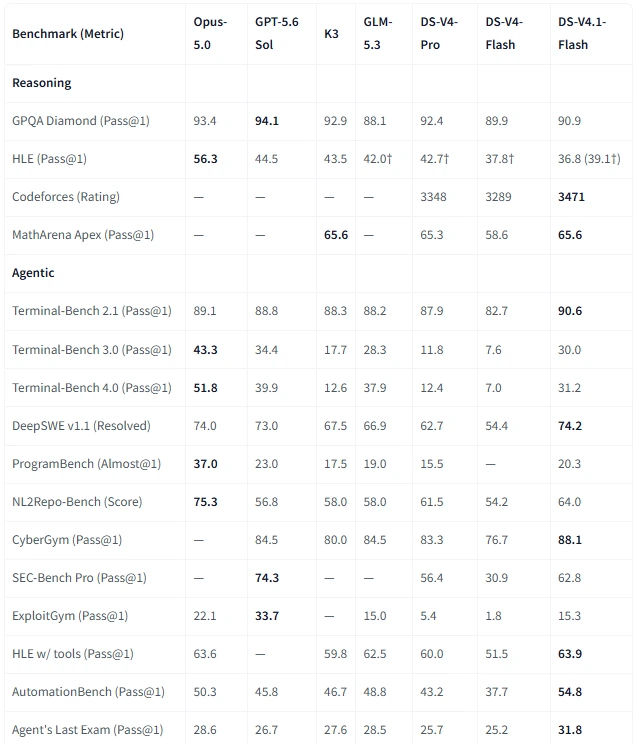
For its code-agent evaluations, DeepSeek reports using agent scaffolds such as DeepSeek Harness Minimal, mini-SWE and Claude Code, generally with maximum reasoning effort, temperature=1.0, top_p=0.95 and large context limits. The scaffold matters: these scores reflect a complete model-plus-agent workflow rather than the foundation model acting alone.
What these results suggest
- V4.1 Flash should be the first model tested for repository-level agents and terminal workflows.
- The lower price does not imply weaker agent performance.
- The result may change with another harness, provider, tool set or permission policy.
- A benchmark pass does not establish secure, maintainable or production-ready code.
- Your acceptance tests must include the patch, tests, unintended changes and human repair time.
Reasoning and knowledge: V4 Pro still has a case
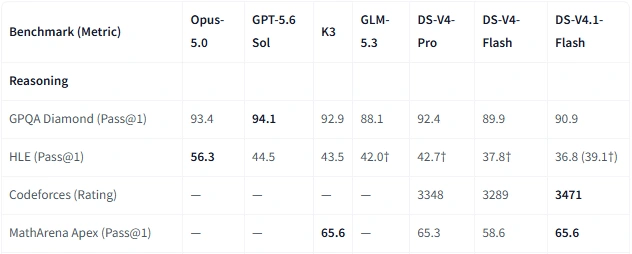
The published comparison is not one-sided. In DeepSeek’s current instruct-model table, V4 Pro remains ahead on selected text-only reasoning evaluations:
| DeepSeek-published benchmark | V4.1 Flash | V4 Pro | Published leader |
|---|---|---|---|
| GPQA Diamond | 90.9 | 92.4 | V4 Pro |
| HLE text-only subset | 39.1 | 42.7 | V4 Pro |
| Codeforces rating | 3471 | 3348 | V4.1 Flash |
| MathArena Apex | 65.6 | 65.3 | Effectively close in the published table |
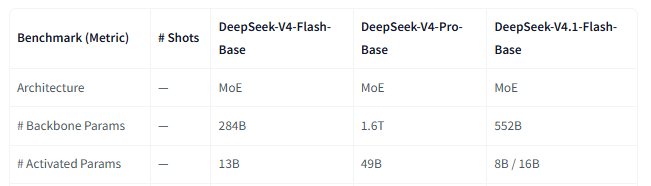
The open-weight base-model results are similarly mixed. V4 Pro leads on several knowledge and long-context evaluations, while V4.1 Flash leads on selected coding and mathematics tests. Base-model scores should not be treated as direct API-chat results, but they help explain why some text-only workloads may still benefit from Pro.
Use V4 Pro only when that potential advantage survives a matched test. A two-point benchmark lead is not economically useful if the application’s real tasks show equal acceptance rates at several times the cost.
Architecture: why Flash can be cheaper without being a small model
V4.1 Flash is a large multimodal Mixture-of-Experts model with a 552B-parameter backbone. Its Causal Encoder–Decoder architecture activates approximately 8B parameters per input token during prefill and 16B during decoding. DeepSeek designed this asymmetry to reduce the compute and KV-cache burden of input-heavy agent workloads.
The official model card also describes:
- A persistent global KV-cache footprint of approximately 890 bytes per token.
- About one-quarter of the global KV-cache footprint of the previous V4 Flash generation.
- A dedicated vision encoder for joint image-and-text processing.
- DSpark speculative decoding.
- A one-million-token trained context route.
V4 Pro‑0813 uses the larger V4 Pro architecture: 1.6T total parameters with 49B activated, plus a DSpark speculative-decoding module in the 0813 release. Its larger capacity can support stronger performance in some knowledge-heavy tasks, but it also creates greater storage and serving requirements.
Active parameters are not the same as model size. A Mixture-of-Experts model may activate only part of the network for each token while still requiring access to the complete set of weights.
Context window and maximum output
Both first-party API models currently advertise:
- A one-million-token context window.
- A maximum output of 384K tokens.
- Thinking and non-thinking modes.
- Automatic context caching under the current DeepSeek service.
These equal limits do not establish equal long-context quality. A fair long-document test should check:
- Facts placed near the beginning, middle and end.
- Instruction retention after long tool histories.
- Cross-document attribution.
- Unsupported additions.
- Prefill latency.
- Cached and uncached token use.
- Output allocation and truncation.
Do not send a one-million-token request merely because the limit permits it. Retrieval, chunking and prompt organization can be cheaper and more reliable than repeatedly sending an entire corpus.
Thinking mode and reasoning effort
Both API models support thinking and non-thinking modes. Thinking is currently enabled by default, with high as the default effort.
| API request | Recommended use |
|---|---|
reasoning_effort="low" | Simple tasks where lower cost and latency matter |
reasoning_effort="high" | Ordinary agent, coding and analytical work |
reasoning_effort="max" | Difficult tasks where a matched test demonstrates enough benefit |
| Thinking disabled | Extraction, transformation, classification and other direct tasks |
For the first-party API, compare the models at the same effort. Do not compare Flash at max with Pro at low and attribute the difference to the model.
- Reasoning tokens are billed as output tokens.
temperature,presence_penaltyandfrequency_penaltycurrently have no effect in thinking mode.top_pis constrained under the documented thinking behavior.- With Tool Calls in thinking mode, previous
reasoning_contentmust be passed back as the current documentation specifies. - Longer reasoning is not proof of a more accurate final answer.
The open-weight V4.1 Flash model card exposes a more continuous internal effort scale for reproduction work, while the hosted first-party API normalizes ordinary client controls to documented levels such as low, high and max. Do not mix open-weight benchmark configuration with hosted-API parameters.
Tool Calls, JSON and API compatibility
At the feature-table level, both models support the same major developer routes:
- OpenAI-compatible Chat Completions.
- OpenAI-compatible Responses API.
- Anthropic-compatible Messages API.
- Tool Calls.
- JSON Output.
- Streaming.
- Chat Prefix Completion in Beta.
- FIM Completion in non-thinking mode.
Shared support does not mean identical reliability. A useful tool test should measure:
Search support clarification checked October 16, 2026: the current Responses guide supports built-in web_search with deepseek-v4-pro, while deepseek-flash ignores it. Flash applications can still use a developer-executed search function or the separate Search and Fetch APIs; selecting Flash does not prohibit retrieval. Those routes require their own integration and billing checks.
- Correct tool selection.
- Valid and complete arguments.
- Unnecessary tool calls.
- Recovery after a failed tool result.
- Number of agent rounds.
- Final answer accuracy.
- Total token cost.
The model proposes tool calls; your application executes them. Validate every tool name and argument, restrict permissions, set timeouts and require human approval for destructive or high-impact actions.
Concurrency, speed and throughput
The current first-party model table publishes a concurrency limit of 2,500 for V4.1 Flash and 500 for V4 Pro. This is a fivefold difference and can materially affect applications with many simultaneous users or parallel agents.
Do not convert those numbers into invented requests-per-minute or tokens-per-minute limits. Concurrency measures active requests, not completed request volume.
A universal latency number is also inappropriate. Actual response time depends on:
- Provider and region.
- Current service load.
- Prompt length and cache status.
- Thinking effort.
- Output length.
- Streaming.
- Tool latency.
- Retries and agent rounds.
V4.1 Flash is architecturally designed for efficient prefill, decoding and KV-cache use, but “Flash is always faster” still requires a provider-specific measured test.
Should existing V4 Pro users migrate?
V4.1 Flash deserves a migration test, but the switch should be treated as a model change rather than a price-only configuration edit.
- Record the current V4 Pro baseline. Preserve prompts, settings, accepted outputs, token categories, latency, retries and correction time.
- Change only the model ID in a test environment. Use
deepseek-flashand keep other variables fixed. - Match thinking settings. Use the same toggle and reasoning effort.
- Control cache state. Compare cache-hit workloads with cache-hit workloads and misses with misses.
- Test representative tasks. Include simple, difficult, long-context, tool, JSON and failure-recovery cases.
- Add vision tests only for Flash. Do not count an unsupported Pro modality as a quality failure.
- Validate structured output. Check both syntax and business meaning.
- Inspect tool behavior. Measure argument errors, rounds and side effects.
- Calculate cost per accepted task. Include retries and human repair.
- Roll out gradually. Start with a small traffic share and monitor regressions.
- Keep a rollback route. Do not remove the known-good Pro path until the Flash migration is stable.
- Monitor lifecycle notices. V4 Pro’s continued availability is current, not guaranteed forever.
A fair V4.1 Flash vs V4 Pro test
A meaningful model test must hold the surrounding system constant. Otherwise, differences in tools, caching, reasoning or hosting can be mistaken for model quality.
Keep these conditions identical
- First-party provider and region.
- Endpoint and protocol.
- System message and user prompt.
- Conversation history.
- Attached files.
- Tool definitions and implementations.
- Thinking toggle and reasoning effort.
- Maximum output.
- Streaming behavior.
- Retry policy.
- Cache state.
- Success criteria.
- Human evaluator.
Record these results
- First completed output.
- Final correctness.
- Instruction-following errors.
- Unsupported claims.
- Tool-selection and argument errors.
- JSON validity and schema compliance.
- Input, cached, reasoning and output tokens.
- Time to first token and total completion time.
- Number of tool rounds and retries.
- Manual correction time.
- Accepted or rejected result.
- Total cost per accepted task.
Preserve the first output before regenerating. When a task has meaningful randomness, run enough matched repetitions to distinguish a consistent difference from one fortunate sample.
Can both models run locally?
Yes. DeepSeek publishes official open-weight repositories for both DeepSeek‑V4.1‑Flash and DeepSeek‑V4‑Pro‑0813, and both model cards use the MIT licence.
That does not make either model a normal laptop deployment. The official full checkpoints are extremely large, and local feasibility depends on:
- Exact checkpoint.
- Precision or quantization.
- Context length.
- Batch size and concurrency.
- Runtime.
- GPU count and interconnect.
- CPU RAM and storage.
- KV-cache placement.
- Vision support.
- Tool and prompt-format implementation.
V4.1 Flash is the more efficient self-hosting candidate of the pair, but even its 552B backbone remains a substantial infrastructure project. Community quantizations may reduce storage and memory requirements while also changing quality, speed, context behavior and modality support.
Do not compare a quantized local Flash deployment with the first-party Pro API and attribute every difference to the underlying models. Hosting, precision, kernels and prompt encoding are part of the result.
Recommended routing strategy
When both models remain available, a measured routing policy can be more useful than selecting one model for every task.
| Request type | Suggested first route | Escalate when |
|---|---|---|
| Classification, extraction or rewriting | V4.1 Flash with thinking disabled or low effort | Validation repeatedly fails |
| Ordinary coding-agent task | V4.1 Flash at high effort | Patch fails defined tests or review |
| Image or screenshot analysis | V4.1 Flash | Use human or specialist review when visual evidence is ambiguous |
| Long-prefix or high-volume agent | V4.1 Flash | Quality falls below the accepted threshold |
| Difficult text-only reasoning | Flash first when cost matters, or matched A/B routing | Defined failure criteria justify a V4 Pro retry |
| High-impact decision | Whichever passes a validated task test | Always require human review rather than relying on model escalation alone |
These are starting rules, not universal recommendations. A routing policy should be based on observed acceptance rates, cost and risk in the actual application.
Frequently asked questions
Which is better, DeepSeek V4.1 Flash or V4 Pro?
V4.1 Flash is the better starting point for most new API workloads because it is cheaper, supports vision, has higher published concurrency and leads many current agentic benchmarks. Choose V4 Pro for built-in Responses web search, or test it for difficult text-only tasks where it delivers a measurable quality advantage. Flash can still use separately integrated retrieval.
Is V4.1 Flash replacing V4 Pro?
DeepSeek initially announced that V4 Pro requests would route to Flash after September 14, 2026. The current change log later reversed that plan and says V4 Pro service will continue in response to user demand. Always recheck the latest lifecycle notice.
Is DeepSeek V4 Pro still available?
Yes, at the October 9, 2026 verification date. The first-party model table still lists deepseek-v4-pro, mapped to DeepSeek‑V4‑Pro‑0813.
Is there a DeepSeek V4.1 Pro?
No separate first-party API model named V4.1 Pro appears in the current Models & Pricing table. Do not create an integration around that expected name unless DeepSeek officially releases and documents it.
Is deepseek-flash the same as V4.1 Flash?
Yes. The current first-party API table maps deepseek-flash to DeepSeek‑V4.1‑Flash.
What happened to deepseek-v4-flash?
The original V4 Flash model was retired. DeepSeek currently accepts the old ID temporarily for compatibility, but serves the request with V4.1 Flash and charges the Flash rate.
Which model supports images?
V4.1 Flash supports image input. The current V4 Pro API route does not. Both return text output.
Can either model generate images?
No native image-output capability is listed for either current API route. V4.1 Flash can understand an image, but image understanding is not image generation.
Do both models have a one-million-token context window?
Yes. Both currently list a one-million-token context and a maximum output of 384K tokens. These shared limits do not guarantee equal long-context accuracy, latency or cost.
Which model is cheaper?
V4.1 Flash is substantially cheaper across current first-party cache-hit input, cache-miss input and output rates. Calculate the complete workload, including reasoning tokens, retries and human repair.
Which model is better for coding?
DeepSeek’s current vendor-reported agent evaluations generally favor V4.1 Flash. Use it as the first coding-agent candidate, then verify patch correctness, tests, tool use and repair effort on your own repositories.
Which model is faster?
V4.1 Flash is designed for more efficient prefill, decoding and KV-cache use, but no fixed provider-independent speed number applies. Measure time to first token, throughput and total task time under matched conditions.
Should I migrate from V4 Pro?
Run a controlled migration test. Switch when Flash maintains or improves the accepted-task rate while reducing cost or latency. Keep Pro when it produces a repeatable, valuable advantage that offsets its higher price.
Are both models open weight?
Yes. DeepSeek publishes official repositories for both, under the MIT licence. Their size still makes full local deployment an advanced infrastructure project.
Sources checked
The following primary sources were checked on October 9, 2026:
- DeepSeek Models & Pricing
- DeepSeek API Change Log
- DeepSeek‑V4.1‑Flash release announcement
- Official DeepSeek‑V4.1‑Flash model card
- DeepSeek‑V4‑Pro GA release
- Official DeepSeek‑V4‑Pro‑0813 model card
- DeepSeek V4 technical report and architecture summary
- DeepSeek Thinking Mode guide
- DeepSeek Vision guide
- DeepSeek Rate Limit & Isolation guide
- DeepSeek Tool Calls guide
- DeepSeek Responses API guide